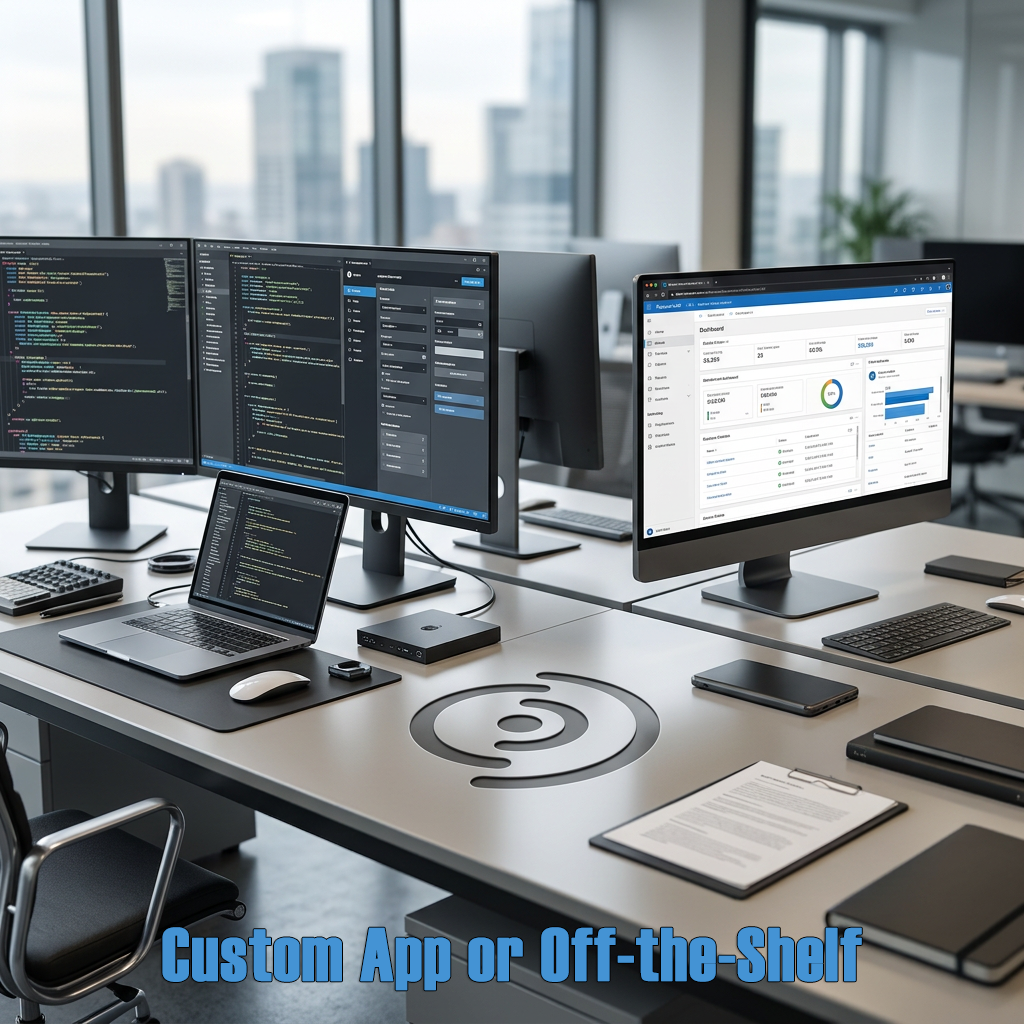
Most small businesses start with off-the-shelf software for good reason — it's affordable, it works on day one, and someone else handles the maintenance. But there's a specific moment when that tool stops serving the business and the business starts serving the tool. The clearest sign isn't that the software is bad. It's that your team has developed a whole shadow system around it: the spreadsheet that lives next to the CRM because the CRM can't do that one thing, the Tuesday morning ritual of copying data from one platform into another, the new hire who needs three weeks just to learn the workarounds. When the workarounds have their own workarounds, you're not using software anymore — you're managing it.
The financial case for staying with off-the-shelf tools is easy to see (monthly subscription, predictable cost) but the cost of staying past the point of fit is much harder to measure. Think about what it actually takes to get a quote out the door, process an order, or generate a report. If the answer involves multiple tabs, a manual step that only one person knows how to do, or data that has to be re-entered because two tools don't talk to each other — each of those friction points has a real labor cost attached to it, week after week. A custom app doesn't make sense for every business, but it starts to make financial sense faster than most people expect when you add up the hours spent on workarounds rather than actual work.
The honest way to evaluate the decision isn't to ask "can we afford a custom app?" but "what is our current setup actually costing us?" A business that processes 20 orders a day and manually copies shipping information into a separate system is spending real money on a problem a custom integration could solve once. A service business whose staff bounces between four tools to complete a single client intake is losing time — and probably making errors — that compound quietly over months. The goal of a good custom build isn't to impress anyone with technology; it's to make the actual workflow of the business match the software, instead of the other way around.